Enabling self-driving labs for synthetic molecule process development
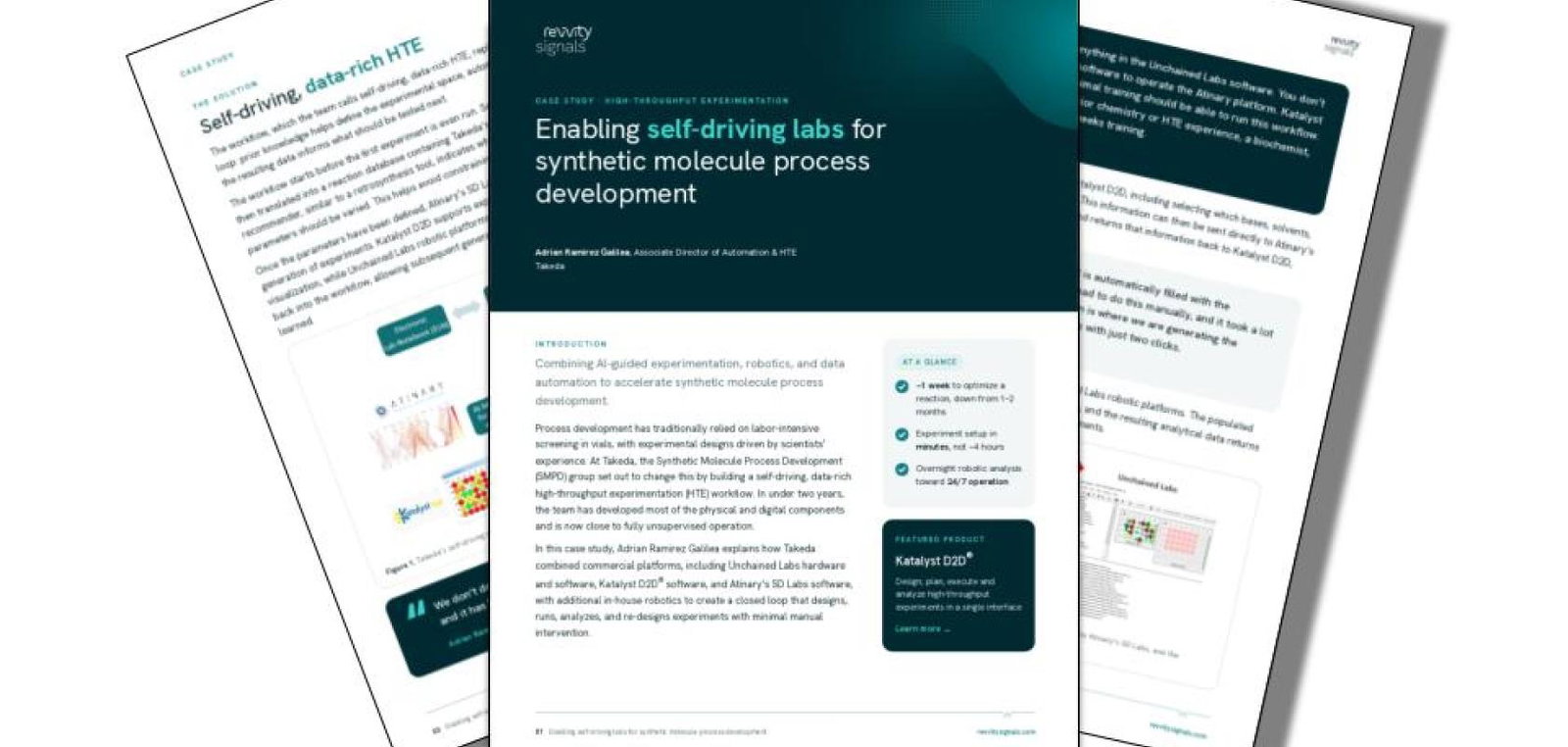
Enabling self-driving labs for synthetic molecule process development - A Revvity Signals case study
Process development has long relied on labour-intensive screening in vials, with experimental designs shaped by a scientist's experience. It works, but it is slow, hard to scale and prone to losing hard-won knowledge once a project ends.
At Takeda, the Synthetic Molecule Process Development (SMPD) group set out to change that. In under two years, its high-throughput experimentation (HTE) team has built a self-driving, data-rich workflow that designs, runs, analyses and redesigns experiments with minimal manual intervention, and is now close to fully unsupervised operation. In this case study, Adrian Ramirez Galilea, Associate Director of Automation and HTE at Takeda, explains how the team combined Revvity Signals' Katalyst D2D software, Atinary's SD Labs, Unchained Labs robotics and in-house mobile robotics into a single closed loop.
Enabling self-driving labs - Who should read it?
This case study is written for process chemists and engineers, HTE and laboratory automation specialists, and R&D informatics teams working on small molecules, peptides and oligonucleotides. It is also valuable for R&D leaders in pharma, biotech and chemicals who are weighing the case for AI-guided experimentation and want to see how a self-driving lab works in practice.
What you will learn about self-driving labs
- The limits of the traditional approach: How heavy outsourcing, limited visibility of external screens, non-FAIR data and lost knowledge held process development back.
- How the closed loop works: How an ELN, a reaction database of prior knowledge and a parameter recommender define the experimental space before AI suggests each new generation of experiments.
- Connecting the physical and digital lab: How standardised 24-well plates, fixed deck positions and a mobile robot enable overnight analysis and move the lab towards 24/7 operation.
- The power of integration: How linking Katalyst D2D with Atinary's SD Labs replaced manual Excel transfers, cutting experiment set-up from around four hours to minutes.
- A real-world example: How a Buchwald-Hartwig coupling with 4,320 possible combinations was optimised in around a week, instead of the one to two months previously needed.
- Lowering the barrier to automation: Why no programming or machine learning expertise is needed, and how a colleague with no prior chemistry or HTE experience was running the workflow after two weeks' training.
Why download this case study?
Self-driving labs are often discussed as a future ambition. This case study shows one in action today, with measurable results and practical lessons from the team that built it. Download it to see how combining commercial and in-house tools can accelerate optimisation, capture richer data and create a workflow that can be replicated across sites.