R&D digitalisation benchmark 2026
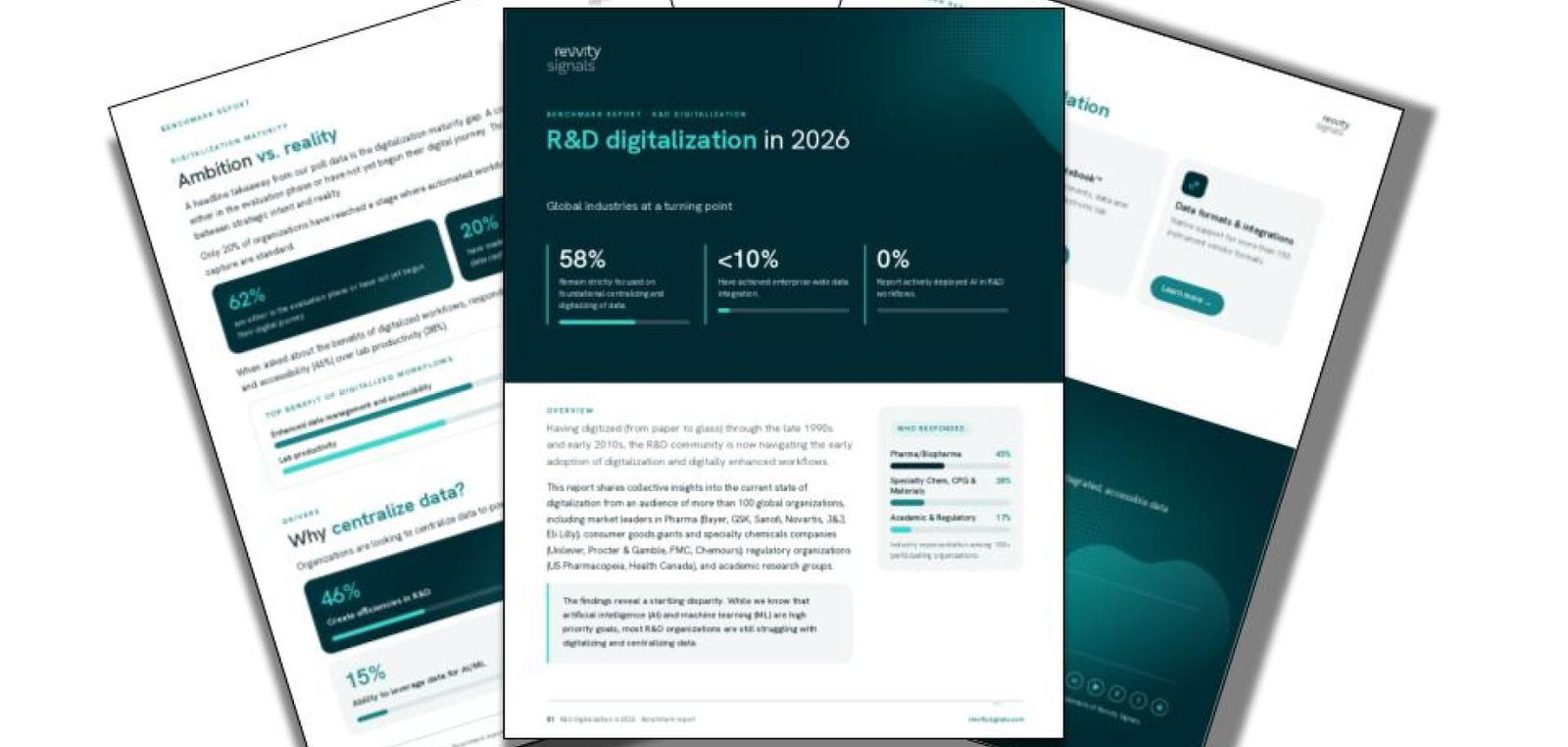
R&D digitalisation in 2026: Global industries at a turning point - A Revvity Signals benchmark report
AI and machine learning sit at the top of almost every R&D strategy. Yet behind the ambition lies an uncomfortable truth. Having moved from paper to glass between the late 1990s and early 2010s, most research organisations are still struggling with the groundwork: getting their data digitalised, centralised and accessible.
This benchmark report from Revvity Signals draws on insights from more than 100 global organisations, including market leaders in pharma such as Bayer, GSK, Sanofi, Novartis, J&J and Eli Lilly; consumer goods and specialty chemicals companies such as Unilever, Procter & Gamble, FMC and Chemours; regulators including US Pharmacopeia and Health Canada; and academic research groups. The findings reveal a striking gap between where R&D wants to be and where it really is.
R&D Digitalisation in 2026 - Who should read it?
This report is written for R&D leaders, laboratory managers, informatics and data science teams, and IT professionals supporting scientific organisations in pharma and biopharma, specialty chemicals, materials, consumer goods, academia and regulatory bodies. It is particularly relevant to anyone building the case for data centralisation, or planning how to make R&D data ready for AI.
What you will learn about R&D digitalisation
- The maturity gap: Why 62% of organisations are still evaluating or have not yet begun their digital journey, and what separates the 20% who have made automated workflows and direct instrument data capture standard.
- The drivers of centralisation: How R&D efficiency, knowledge continuity, AI/ML readiness and data governance rank as reasons to centralise data.
- The real cost of data preparation: Why scientists and data professionals still spend 10 to 11 hours a week collecting and preparing data, and how widespread spreadsheet reliance remains.
- The biggest obstacles: How heterogeneous data formats, technique-specific silos and legacy systems create digital islands that are stored but functionally inaccessible.
- The state of analytical data integration: Why only 9% of respondents have achieved enterprise-wide integration of analytical data.
- What accelerates progress: Why alignment between scientists and IT, and clear leadership sponsorship, matter more than any single technology.
- AI readiness in practice: Why none of the organisations surveyed has yet deployed AI/ML in core R&D workflows, and what has to happen first.
Why download it?
AI cannot deliver on its promise without the right data foundation, and this report shows how far most R&D organisations still have to go. Download it to benchmark your own organisation against more than 100 of your peers, understand where the biggest barriers lie, and build a clearer case for the data infrastructure that advanced analytics and AI will depend on.