
Scientific computing has moved out of the specialist computing centre and into the strategic planning of laboratories, engineering teams and research-led businesses. Behind that shift are people: infrastructure leaders, informatics directors, simulation specialists and research computing managers who are translating rapidly evolving technology into reliable, usable, trusted outcomes. The inaugural SCW75 brings together 75 of the most influential of them, and their collective experience reveals as much about the challenges ahead as it does about the progress already made.
Research communities that once appeared distinct are increasingly converging around similar infrastructure needs. A bioinformatician, automotive engineer, computational chemist and semiconductor researcher may use different tools and datasets, but they all depend on scalable compute, high-performance storage, workflow orchestration, robust data management and software that can bridge specialist domains.
Analyst data points to the scale of this shift. Hyperion Research has reported that the HPC, AI and technical computing market grew by 23.5% in 2024 and projected that the overall HPC and technical computing market will exceed $100 billion by 2028. It also reported that AI is now used by more than 78% of HPC sites worldwide. Intersect360 Research has indicated that the worldwide market for accelerated and high-performance data centre infrastructure serving AI workloads reached $193bn in 2024, up 121% year-on-year, with the HPC segment growing by 24.1%.
These figures suggest that scientific computing budgets are expanding upward into larger AI and HPC systems, and outward into the data, workflow, governance and software layers needed to translate that capacity into reliable scientific and engineering outcomes.
Spending is rising, but so are expectations
Of the respondents to our SCW75 survey, 23% report they are planning to increase spending significantly, by more than 20%, while 34% plan to increase spending moderately, by between 5% and 20%. The survey also indicates that many respondents are already responsible for sizeable projects or infrastructure, with 34% reporting that they manage projects or infrastructure of more than £5m and 23% reporting budgets of between £1m and £5m.
This spending will likely not be confined to traditional HPC centres. Hyperion Research’s public cloud forecast indicates that HPC-AI cloud spending is projected to grow by almost 20% annually between 2025 and 2029, with biosciences and computer-aided engineering (CAE) among the key verticals.
For lab-based industries, the figures underline the growing role of computation in research workflows.
Pharmaceutical, biotechnology, chemical and materials companies increasingly rely on computational methods to manage complex data, guide experiments, accelerate candidate selection and support decision-making.
Their needs, however, extend beyond raw compute into laboratory informatics, data governance, secure access controls, auditability and integration with
experimental workflows.
In engineering, simulation, CAE and digital engineering tools are being used to reduce physical prototyping, improve design confidence and shorten development cycles, with cloud-based deployment growing faster than the overall CAE market.
AI is changing how simulation is used
The most immediate force behind this transformation is AI computing. The rapid adoption of machine-learning, foundation models and data-intensive analytics has created strong demand for GPUs, high-bandwidth memory, specialist storage, fast networking and cloud-based compute capacity.
But in scientific computing, AI is not replacing established modelling and simulation methods. Instead, it is increasingly being combined with them. In engineering, AI is being used to accelerate design-space exploration, build surrogate models and reduce the cost of repeated simulation. In life sciences, it helps researchers interpret genomics, imaging, real-world data and experimental results. In materials science and chemistry, AI is being used to search vast chemical and materials spaces that would be impractical to explore experimentally.
That shared dependence is reshaping spending priorities. Organisations no longer invest only in faster machines or larger clusters. They are also spending on cloud platforms, data pipelines, observability tools, software licences, workflow systems, storage architectures, model validation frameworks and specialist staff. The pressure is not simply to run bigger jobs, but to make computational work more accessible, trusted and repeatable.
Samar Aseeri, Computational Scientist at the King Abdullah University of Science and Technology, noted that the practical adoption of advanced computing can be as important as the technology itself: “A significant challenge is bridging the gap between rapidly evolving computational technologies and their practical, scalable adoption in research environments.”
Aseeri also highlighted the human and ecosystem challenges that can accompany technical change. “There is often a gap between advanced computational methods and the researchers who could benefit from them. Addressing this requires not only technical innovation, but also sustained efforts in education, community building and knowledge transfer,” he said.
That point is central to the current investment cycle. The limiting factor is whether these systems can be embedded into everyday scientific workflows without creating new barriers for researchers and engineers.
Lab-based industries need trusted data as much as compute
The challenge is especially visible in lab-based industries. These increasingly depend on computational approaches, but their workflows are constrained by experimental validation, regulation, data quality and reproducibility. AI can help identify promising candidates, optimise processes or detect patterns in complex datasets, but scientific value still depends on whether those outputs can be tested, explained and trusted.
Our SCW75 survey responses repeatedly point to this issue. Respondents identified validation, reproducibility and trustworthiness as major challenges, particularly where computational models must be checked against incomplete, indirect or expensive real-world data. They also highlighted the difficulty of accessing high-quality, integrated and AI-ready multimodal data, especially in sensitive clinical and medical contexts.
That makes scientific computing investment in lab-based industries broader than merely the price of buying GPUs and servers. Organisations need electronic lab notebooks (ELNs), laboratory informatics management systems (LIMS), scientific data platforms, workflow systems, metadata standards and integration layers that can connect instruments, experiments and computational models. That means linking sample metadata, assay results, instrument files, experimental protocols, quality records and computational outputs in ways that can be searched, governed and reused.
Without those foundations, the cost of AI and HPC could rise, with no corresponding improvement in productivity. A model trained on incomplete or poorly described data may produce outputs quickly, but that has limited value if researchers cannot trace the source data, reproduce the workflow or understand the confidence attached to the result.
Engineering spending is being pulled towards simulation and digital design
For engineering industries, the same issue appears in a different form. Simulation and digital engineering can reduce the need for physical prototyping, shorten development cycles and improve design confidence. However, this places greater pressure on the credibility of models, the quality of input data and the ability of engineers to understand uncertainty. As AI enters these workflows, organisations must ensure that speed does not come at the expense of reliability.
The practical use cases are increasingly broad. Automotive and aerospace engineers use simulation for aerodynamics, crash analysis, thermal management and structural performance, while electronics, semiconductor, energy and machinery companies use digital models to explore system behaviour before physical assets are built or modified.
Recent consolidation in engineering software shows the strategic value being placed on simulation and AI-enabled design. Siemens completed its acquisition of Altair Engineering for an enterprise value of approximately $10bn, adding capabilities in mechanical and electromagnetic simulation, HPC, data science and AI. Synopsys completed its acquisition of Ansys in 2025, positioning the combined company in an expanded $31bn total addressable market. Cadence also completed its acquisition of Hexagon’s design and engineering business in 2026, strengthening its position in physical AI, multiphysics and system design.
These deals perhaps indicate that major engineering software suppliers expect growing demand for integrated simulation and AI-enabled design workflows. For engineering companies, the supporting infrastructure increasingly includes cloud HPC, on-premises clusters, GPU capacity, high-speed storage and data management systems. The goal is not simply to replace physical testing, but to use computation earlier and more frequently in the design cycle, with physical validation reserved for where it adds the most value.
Strategy becomes a scientific challenge
As scientific computing becomes more central to research and industrial strategy, infrastructure planning becomes harder. The challenge is no longer only technical performance. It also involves sovereignty, procurement timing, access, governance, energy use and the ability to update systems.
Sadaf Alam, CTO and Director of Advanced Computing Strategy at the Bristol Centre for Supercomputing, University of Bristol, said: “The most significant challenge in scientific computing today is not technical; it is architectural and strategic: delivering sovereign, sustainable, and federated AI infrastructure at the pace science and policy demand, while the underlying technology landscape changes faster than any procurement or governance cycle can accommodate.”
Alam’s point captures a tension facing national facilities, universities and large industrial users. AI hardware generations can move faster than procurement, facilities planning and governance processes. Capacity may exist, but it still has to be made securely and equitably available to health researchers, government agencies, industry and early-career researchers. Energy usage and sustainability add a further constraint.
“These three challenges are interdependent. Solving any one without the others simply moves the bottleneck. The field needs infrastructure leaders who can hold all three in view and design systems that address them together,” added Alam.
Complexity is now a cost issue
As organisations spend more on HPC, AI and cloud infrastructure, the cost of underutilisation also rises. A poorly optimised workload is no longer just a technical inconvenience; it can mean wasted GPU hours, higher cloud bills, increased energy consumption and delayed research.
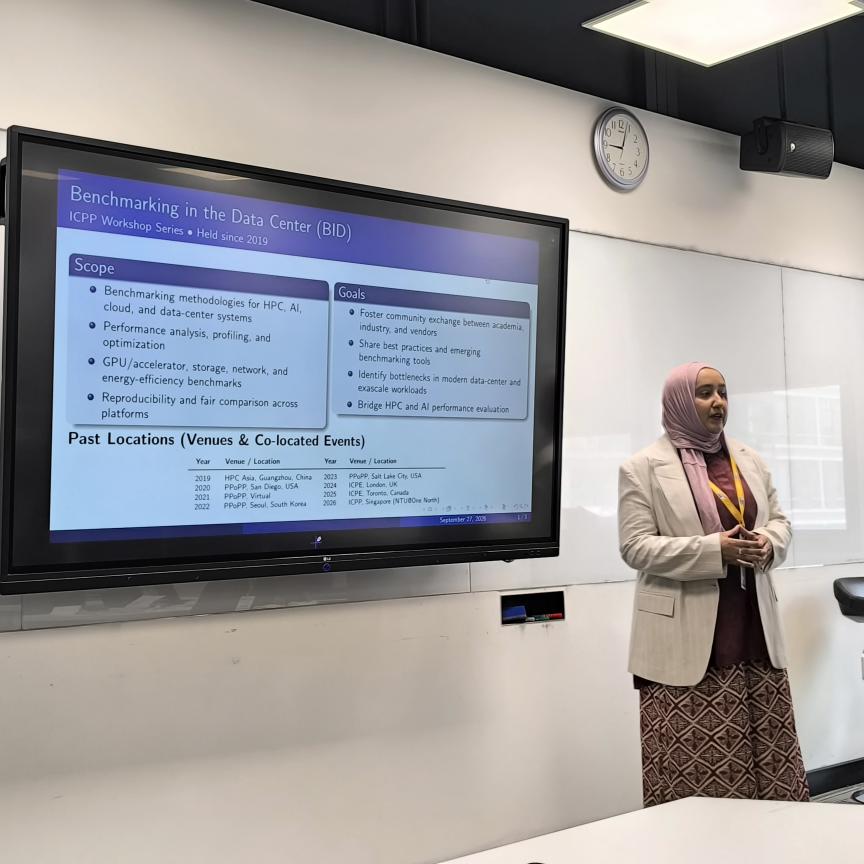
Ayesha Afzal, Researcher at Erlangen National High Performance Computing Center, calls this a ‘transparency crisis’ – “the widening gap between the extreme complexity of exascale architectures and our ability to predict, interpret and optimise their behaviour”.
Scientific computing environments are heterogeneous, combining CPUs, GPUs, specialist accelerators, distributed storage, cloud resources and complex software stacks creating powerful capabilities. But it also makes systems harder to optimise, debug and explain.
“We have reached a point where trial-and-error benchmarking is no longer a viable engineering strategy; it is a costly and unsustainable barrier to entry,” said Afzal.
This argument is particularly relevant as energy and cloud costs become more visible. Organisations need better ways to predict performance, understand bottlenecks and quantify trade-offs between runtime, cost and power consumption before deployment. Without that visibility, scientific computing becomes harder to plan and justify.
For many domain scientists, a barrier to progress may therefore be usability rather than raw capacity. Advanced tools exist, but they remain difficult to use in routine research settings. If scientific computing can only be used effectively by a small group of specialists, the benefits of investment will be limited.