Researchers at MIT have developed a machine learning approach that could enable artificial intelligence (AI) models to simulate a broader range of physical systems and conditions without requiring extensive retraining.
The work addresses a challenge in AI-based physical simulation: models trained on a particular set of conditions can struggle when presented with scenarios outside the range of their training data. This can limit their usefulness for applications such as engineering design, materials science and climate modelling, where systems can behave differently as physical conditions change.
The MIT researchers developed a method that gives AI models what they describe as a better "feel for physics", allowing them to generalise more effectively to situations they have not encountered during training.
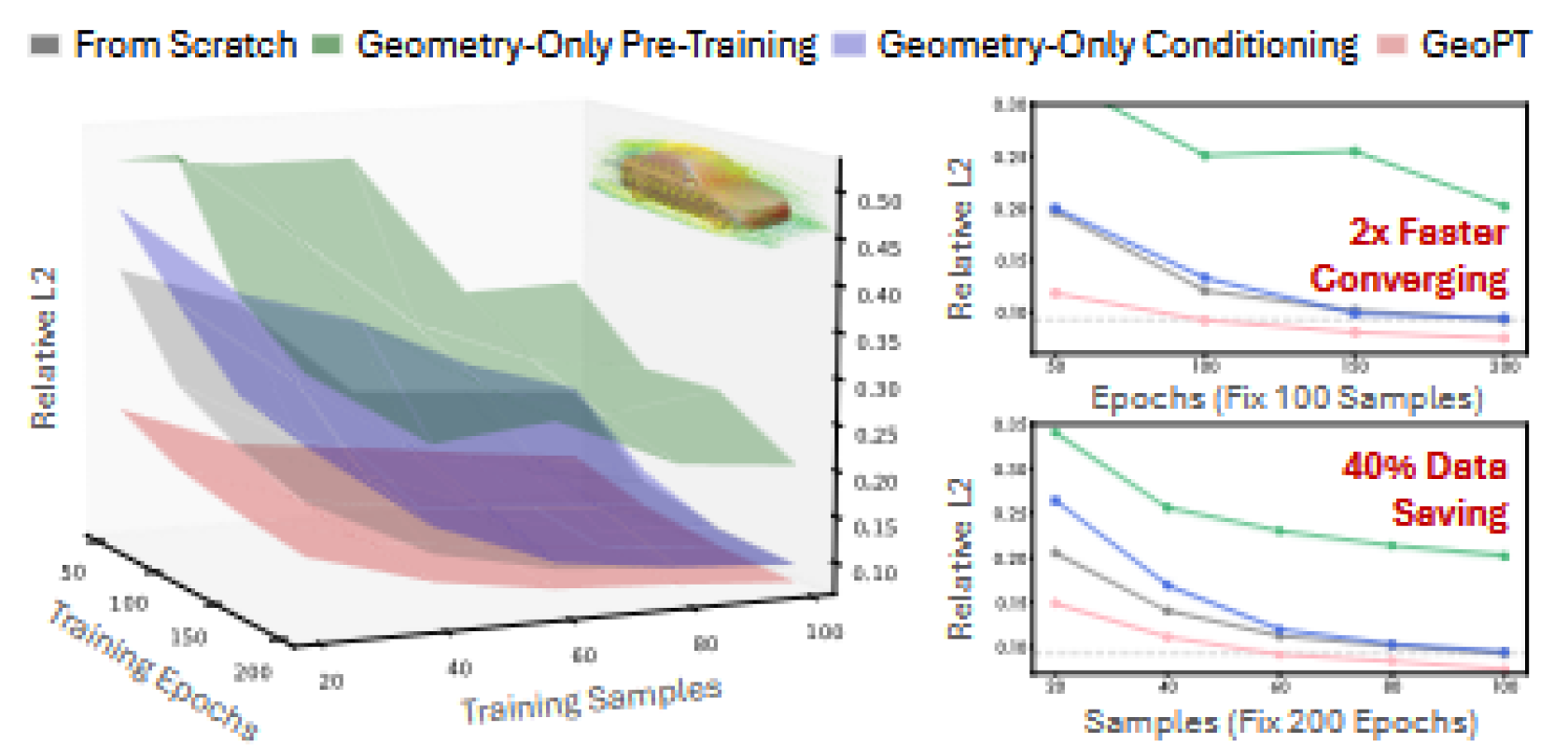
“We believe physics is the third modality for AI models, after text and pixels,” noted MIT PhD student and CSAIL researcher Minghao Guo, a co-lead author on a paper introducing GeoPT. “Our general-purpose model has the versatility to help build a world model for physics. Many models, such as those that generate robotics data and videos, are already well-versed in textual and visual data, but with physical accuracy, they’ll get more realistic results.”
Rather than training an AI model to reproduce individual examples, the researchers incorporated information about the underlying physical system into the learning process.
The approach is designed to help models identify relationships between physical variables, rather than simply learning correlations present in their training datasets. As a result, the model can use those relationships to make predictions when operating conditions change.
The researchers tested the method on physical systems involving fluid dynamics and other forms of physical behaviour, assessing how well the models could generalise beyond the conditions represented in their training data.
The researchers found that models incorporating this physical understanding could produce accurate simulations across a wider range of scenarios than conventional machine learning approaches.
This is important for scientific computing because generating training datasets for every possible physical condition can be computationally expensive. Traditional numerical simulations can themselves require substantial computational time, particularly when modelling complex systems at high resolution.
Reducing reliance on training data
The technique could therefore reduce the amount of data required to develop AI-based simulation models.
Instead of relying exclusively on large datasets of simulated or experimental results, the model can incorporate knowledge of the governing physics to constrain its predictions. This can improve its ability to extrapolate beyond the examples used during training.
The researchers said the approach could be useful where obtaining training data is difficult or expensive, such as for physical systems that are challenging to simulate or experimentally reproduce.
AI-based surrogate models are increasingly being investigated to accelerate computationally intensive scientific simulations. Once trained, these models can produce predictions much faster than conventional numerical solvers, potentially allowing researchers and engineers to explore more design configurations or physical conditions.
However, ensuring that surrogate models remain reliable outside their training distribution remains a significant challenge. The MIT research addresses this issue by placing greater emphasis on the physical relationships underlying the data.
Applications in engineering and science
The researchers believe the approach could eventually support applications in which AI models need to operate under changing physical conditions.
In engineering, this could include exploring different designs, materials or operating environments without having to train a separate model for every scenario. In scientific research, models capable of generalising across physical regimes could help researchers investigate systems where experimental data is limited.
The work also highlights the potential to combine machine learning with established scientific knowledge rather than treating AI as a replacement for physics-based modelling.
By giving AI models a stronger representation of the physical principles governing a system, the researchers aim to create simulation tools that are both faster than conventional numerical approaches and more robust when conditions change.
For scientific computing, this could help bridge the gap between traditional high-fidelity simulations and data-driven AI models, enabling researchers to apply machine learning to a wider range of physical problems without requiring prohibitively large training datasets.