
Every experiment is valuable. It might not prove what the researcher hoped it would—making it, technically, a negative result—but it might prove exactly what another researcher was looking for. At the very least, one researcher’s discovery will help others refine their research strategies. This is truer now than ever, as AI has removed much of the human bottleneck in reviewing and analysing scientific literature.
The scientific progress that becomes possible if all research—not just the experiments that support the hypothesis a researcher was trying to prove—is available in a standardised format, with complete annotations, and in a timely manner, is extraordinary.
Industry has made digital data management a strategic priority for precisely this reason. In fact, some organisations will hire candidates with stronger data management skills over those with stronger chemistry skills.
However, academic chemistry records remain largely paper-based,[1] with communication of the results often only partial and years after the fact, through publications. There remains relatively little sharing of individual experimental results, especially negative findings,[2] with the wider scientific community or even, in an easily searchable format, within research groups.
As so often, there are several barriers to making academic research available in a comprehensive, timely, and standardised way. The biggest barrier of all, however, is the paper lab notebook. Experimental data that are not captured digitally at the point an experiment is conducted are, by and large, lost. Researchers, like most other professionals, simply do not have the time to transfer data into digital systems later, and experimental results remain in paper notebooks until those notebooks are eventually discarded or destroyed.
Industry has largely solved this challenge by mandating the use of electronic lab notebooks (ELNs). ELNs can capture complete experimental data and make it shareable across research teams—creating one of an organisation's most valuable intellectual assets.
Clearly, a world in which academic chemists use ELNs at scale is appealing. No experiment is wasted. Scientific progress becomes faster, more reproducible, and more collaborative. Researchers can publish more quickly, and knowledge is no longer lost when researchers move on from a research group.
A 2023 editorial in Nature proclaimed, “For chemists, the AI revolution has yet to happen”.[3]
So what is stopping the widespread adoption of electronic lab notebooks in academic chemistry?
- Resources. Many academic labs lack the foundational infrastructure required, ranging from computers and reliable Wi-Fi in laboratories to the funds needed to purchase them.
- Skills. Digital data management is, by and large, absent from chemistry curricula. Many academic scientists simply have not been taught how to manage experimental data digitally. This should be addressed, given the importance industry now places on these skills.[4]
- Security and trust. Possibly stemming from this lack of training and familiarity with digital information management, many academics remain uncertain whether their research data are truly secure in digital environments.
- Cultural barriers. Academic chemistry careers rise and fall on publications in high-impact journals. Secrecy around early-stage data before publication is not a character flaw but often a necessity for researchers seeking to avoid being scooped.
- A structural lack of central sponsors. The collective benefit of digital data management is obvious. Whether within a single research group or across the global scientific community, the collective benefits from the knowledge contributed by the individual. Yet the incentive for any individual researcher to contribute their own data is comparatively limited. Industry overcomes this challenge through central decision-makers who recognise the value to the organisation as a whole and can mandate the use of ELNs. Those central sponsors are, however, largely absent in academia.
Despite the barriers to adoption, digital data management may prove to be one of the greatest accelerators of scientific progress. With the rise of AI unlocking a new wave of discovery, it falls to our generation to build the data infrastructure that makes this possible. We believe there are several key actions that will unlock the sharing of comprehensive, standardised experimental data in real time.
Our priorities to enable the AI revolution for chemists
- Engage central decision-makers—funders, publishers, and learned societies—to encourage, and potentially mandate and enforce, the adoption of digital data management infrastructure.
- Embed digital data management into chemistry curricula, for example, through the use of pedagogical ELNs in undergraduate laboratories.[5]
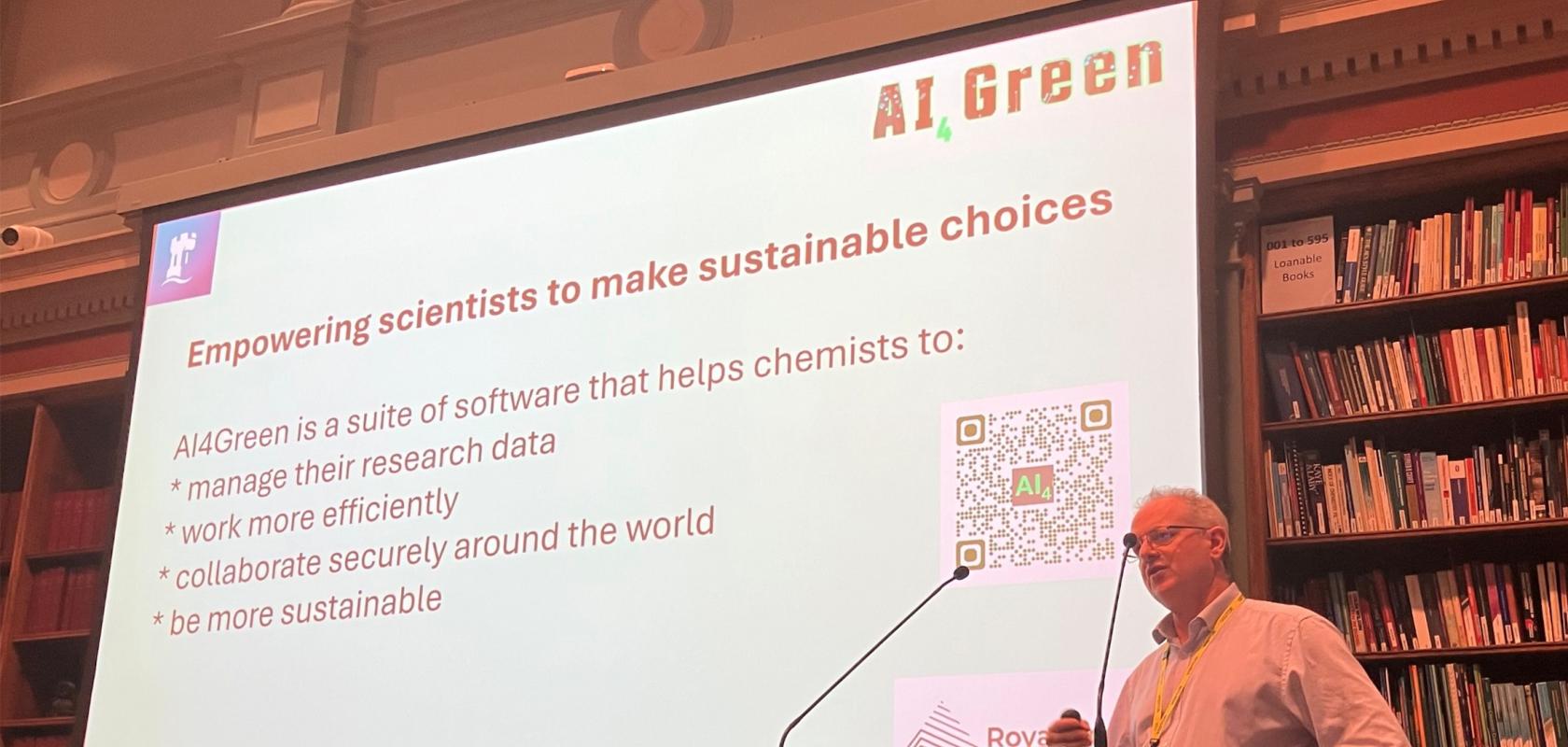
Work with industry to communicate the importance of teaching chemists strong digital data management skills, to ensure graduates are set up to thrive in industry. - Support academic laboratories in overcoming resource barriers by providing free or heavily discounted electronic lab notebooks, alongside assistance with hardware and infrastructure where needed. This point has been the primary motivation for our development of AI4Green, an open-source ELN.[6]
Every experiment increases what humanity knows. It falls to our generation to ensure that knowledge does not disappear with the notebook it was written in.
The greatest step change in scientific progress over the decade may not come from a new scientific discovery. It may come from fundamentally changing how we capture, preserve, and communicate scientific knowledge.
References:
[1] Kanza, S.; Willoughby, C.; Gibbins, N.; Whitby, R.; Frey, J. G.; Erjavec, J.; Zupančič, K.; Hren, M.; Kovač, K. Electronic Lab Notebooks: Can They Replace Paper? J. Cheminform. 2017, 9, 31.
[2] F. Strieth-Kalthoff, F. Sandfort, M. Kühnemund, F. R. Schäfer, H. Kuchen, F. Glorius. Machine Learning for Chemical Reactivity: The Importance of Failed Experiments. Angew. Chem. Int. Ed. 2022, 61, e202204647.
[3] For chemists, the AI revolution has yet to happen. Nature 617, 438 (2023)
[4] https://www.rsc.org/globalassets/22-new-perspectives/discovery/future-workforce-and-educational-pathways-interim-report/chemistry-future-workforce-and-education-pathways-data-report.pdf
[5] https://ai4g4s.app
[6] https://ai4green.app
Jonathan Hirst is a Professor of Computational Chemistry at the University of Nottingham.
Joe Heeley is a Postdoctoral Researcher at the University of Nottingham whose work focuses on the use of machine learning to develop and encourage sustainable processes in chemical synthesis.
Dr Ann-Kathrin Kotte is the Chief Operating Officer of governr and an advisor to AI4Green. Ann-Kathrin Kotte has a PhD in Molecular Microbiology from the University of Nottingham.